don't look down
free webcam tightrope game · browser
what is don't look down?
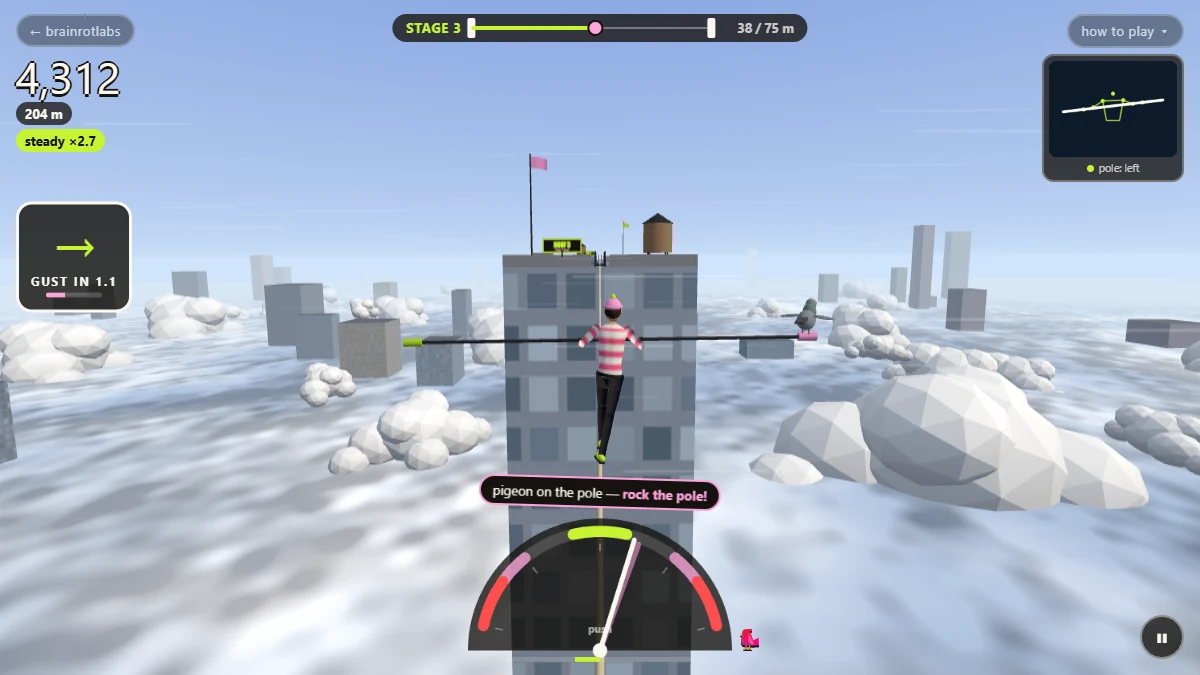
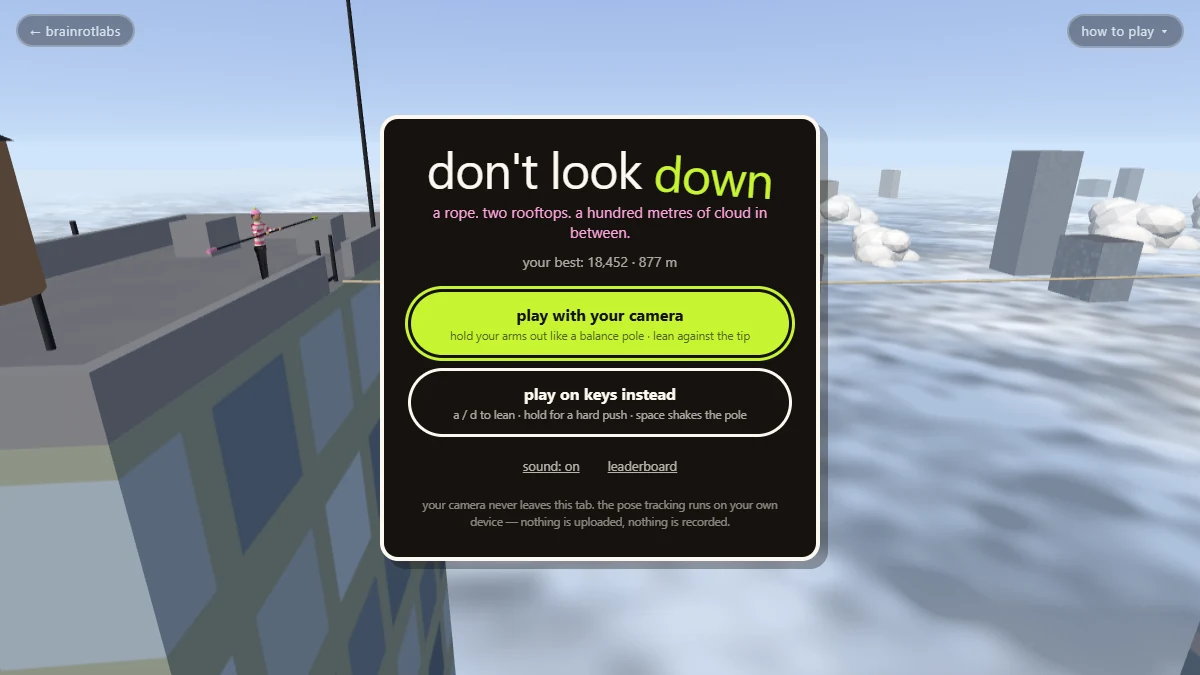
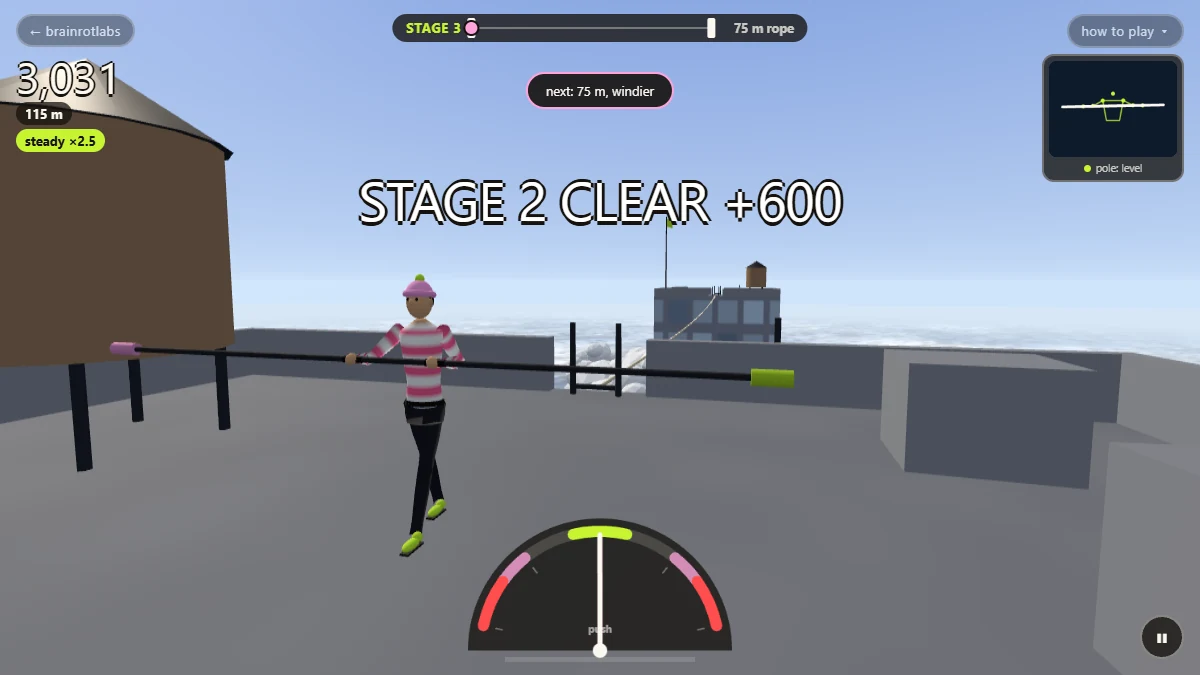
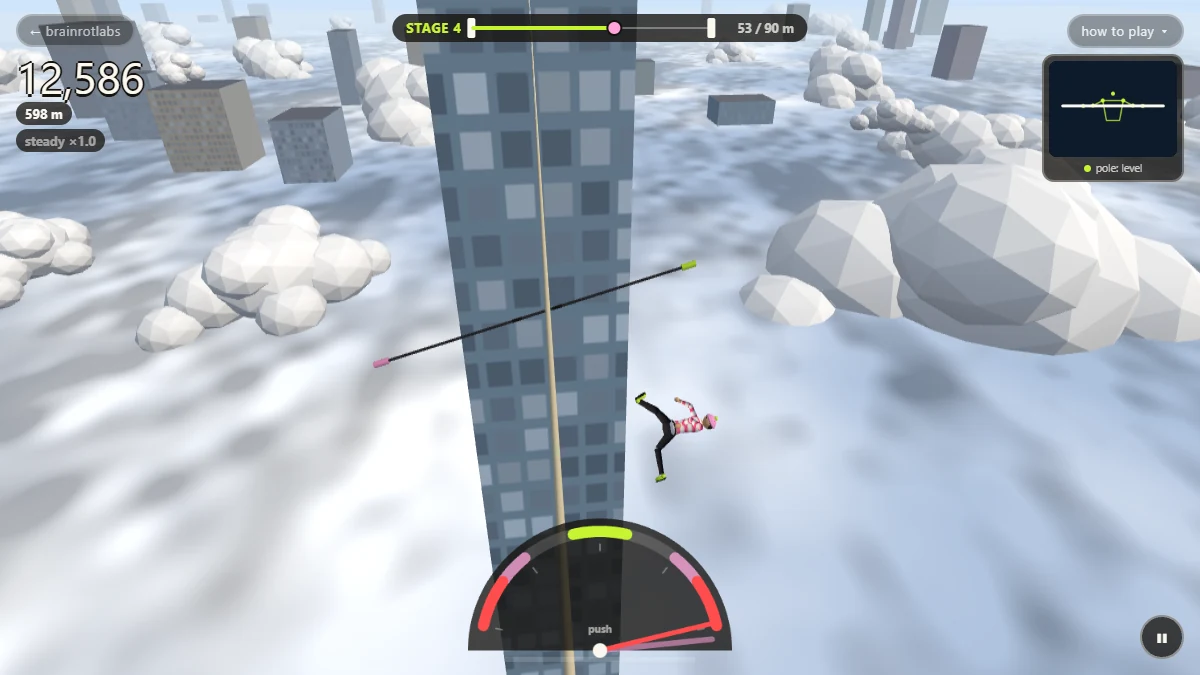
Don't Look Down is a free browser game you play with your body. Somebody has strung a rope between the roofs of two skyscrapers, and a hundred metres below it the city has disappeared under a sea of cloud. A tightrope walker is going across, one careful foot in front of the other, carrying a long balance pole — and the pole is your arms.
He walks on his own; your whole job is keeping him upright. Hold your arms out in front of your webcam and a pose model running inside the tab reads the tilt of the line between your hands. Dip a hand and you push him that way. Nothing is uploaded and nothing is recorded — and if you would rather not turn a camera on at all, the keyboard plays the whole game against exactly the same physics.
how to play
With the camera, stand or sit where both of your hands are in the picture and hold your arms out to the sides. Before the first walk the game asks you to hold them level for a second — that is your centre. After that:
- push him left — dip your left hand, or lean your body to the left.
- push him right — dip your right hand, or lean right.
- shake the pole — rock your arms like a see-saw, fast, three or four times.
On keys:
- A or ← pushes left, D or → pushes right. A tap is a gentle nudge; hold the key and the push keeps building to a hard shove.
- space shakes the pole.
- P, M and R pause, mute and restart.
On a phone or tablet, drag left or right anywhere on the screen — how far you drag is how hard you push — and tap shoo to shake the pole. The preview is a mirror, so your left hand is on the left of the screen and pushes him to the left of the screen.
the rules
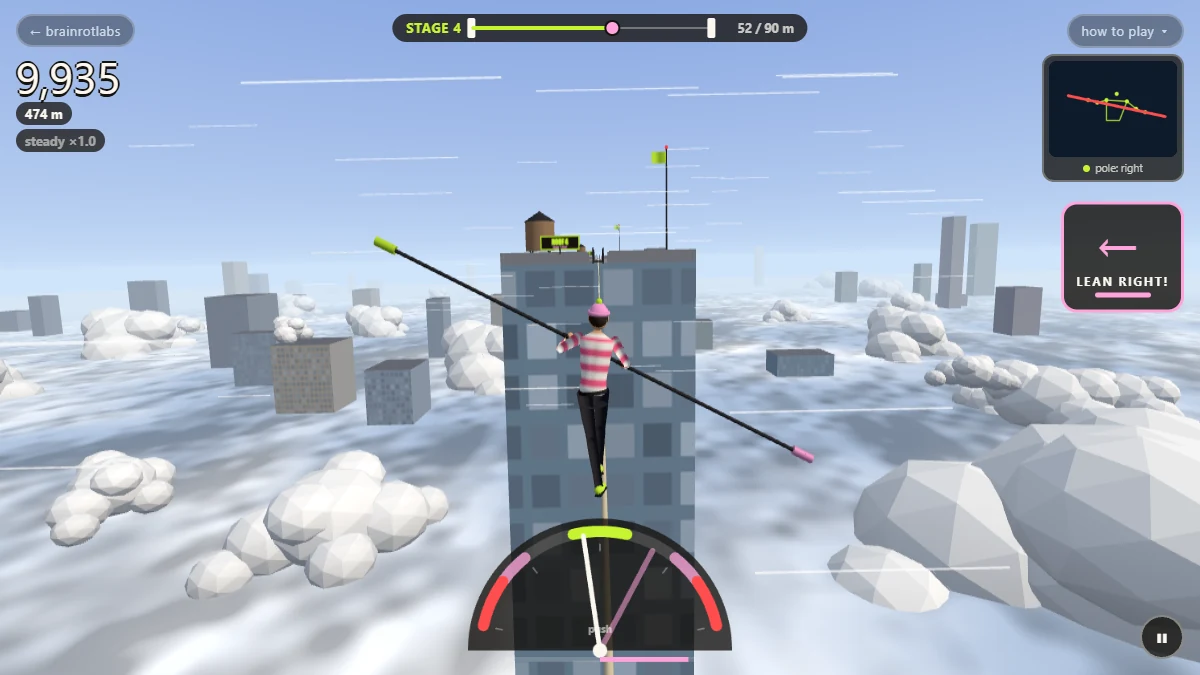
- Left alone, he falls. A walker on a rope is an upside-down pendulum: a small tip becomes a bigger one unless something pushes back. The gauge at the bottom of the screen is how far over he is.
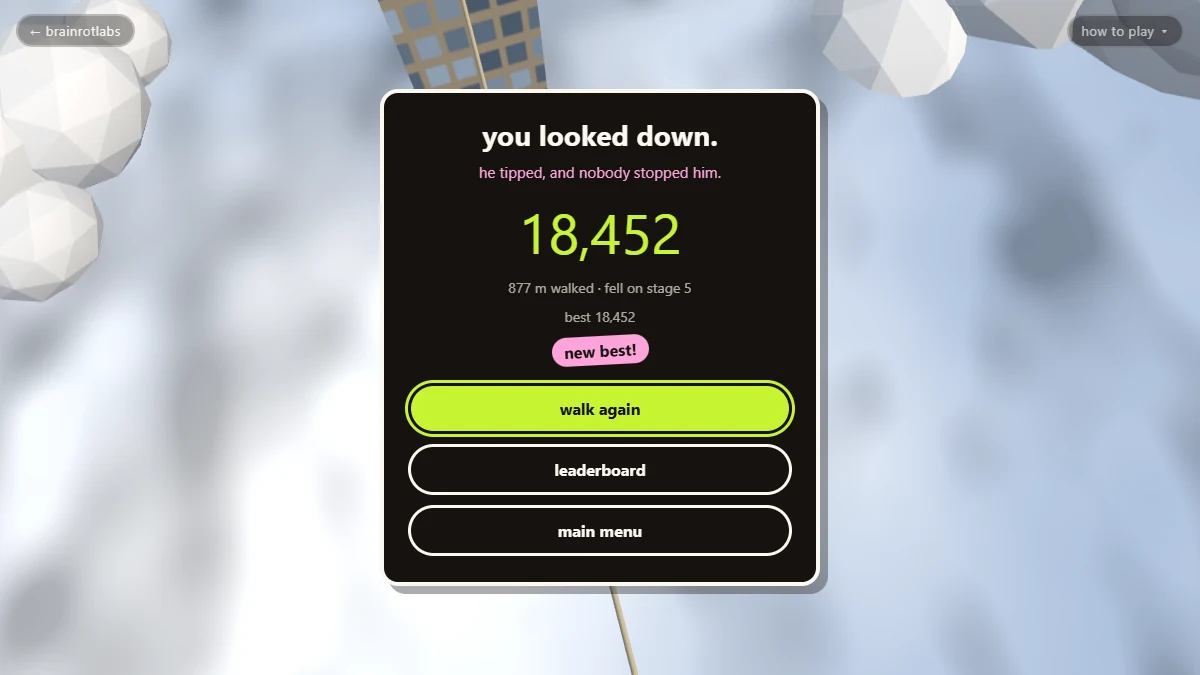
- One fall ends the walk. There are no lives. Every roof you reach is a cleared stage and a bonus, but it is not a checkpoint.
- Gusts are announced. An arrow appears on the side the wind comes from, with a countdown; the flags on the towers swing round; and you hear it arrive from that side. Lean into it before it hits.
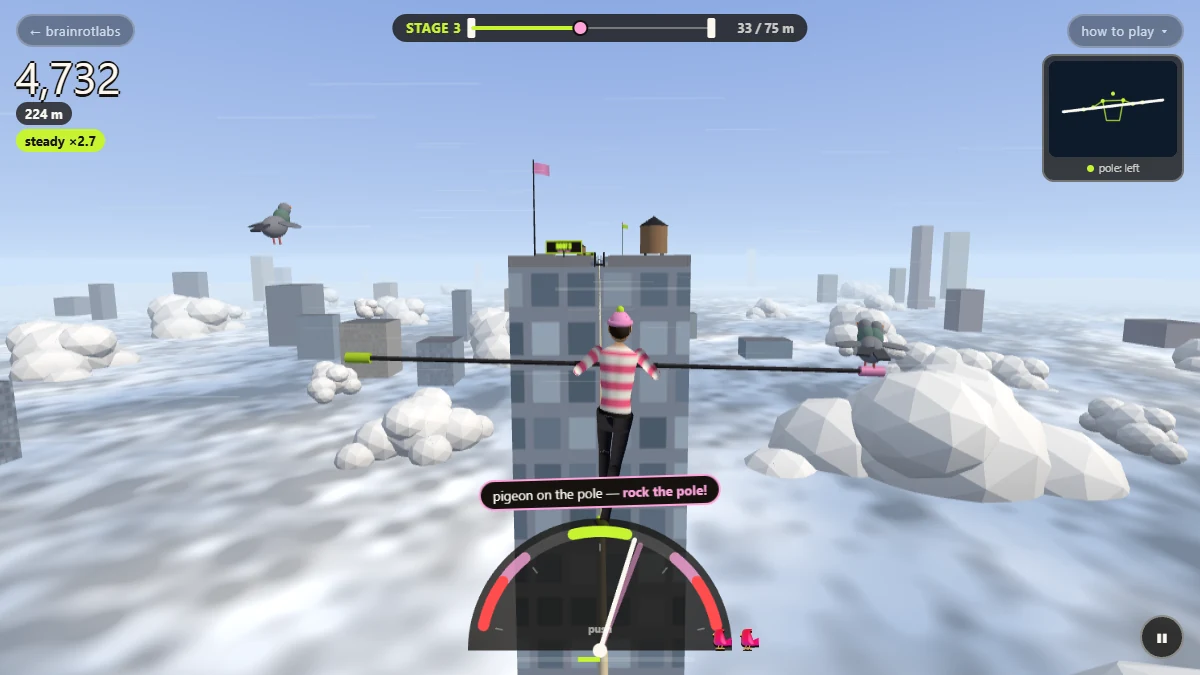
- Pigeons are weight. From stage 2, pigeons land on the ends of the pole, and every one pulls its end down. They leave on their own eventually — long after they have tipped you over.
- The middle of the rope moves. A rope barely moves at its anchors and swings most at mid-span, so the hardest stretch of every span is the middle of it.
- He slows down when he is struggling. A walker tipped a long way over stops to fight it, so a wobbly walk is a slow walk.
- Every span is harder. Each rope is longer than the last, the gusts come stronger and more often, and he gets less forgiving about being tipped.
scoring
Every metre across a rope is worth 10 points, times a steady multiplier that climbs toward ×3 while you keep him close to upright and drops straight back to ×1 the moment he wobbles hard. Reaching a roof is worth 300 points times the stage number, each pigeon shaken off the pole is 75, and dragging him back from the very edge of a fall is a SAVE worth 200. The world board ranks points, not metres — two players who walk the same distance are separated by how steadily they walked it. Your best is kept on your own device, and a walk good enough for the top 100 can be posted to the world board under a name you choose once.
tips
- Watch the ghost, not the needle. The faint pink needle on the gauge is where he will be a third of a second from now. A tip that is already shrinking needs nothing from you; a small tip that is still growing needs a push right now.
- Small and early. Almost every fall that is not a gust is an over-correction — a hard shove that throws him past upright and off the other side. Nudge, wait, nudge.
- Lean into the arrow. The gust arrow points the way the wind blows. Start pushing the other way as the countdown runs out, not after he has started to go.
- Shake pigeons off immediately. A pigeon costs you nothing to shake off and a steady multiplier to carry.
- Keep your hands wide. The camera reads the tilt of the line between your hands, and a long line tilts more clearly than a short one. A broom handle works as a prop, as long as your hands stay far apart on it.
- Protect the multiplier. At ×3 every metre is worth three times what it was. Walking steadily through a calm stretch is where the big scores come from.
screenshots
your camera and your privacy
The camera is opt-in: the game never asks for it until you press play with your camera, and the rest of the site cannot ask for it at all. When you do, the pose model is downloaded once and runs inside your browser tab. Frames go from your camera into that model and nowhere else — they are not uploaded, not recorded, and not sent to us or to anyone. Close the tab and there is nothing left. The details are in our privacy policy.
features
- your own arms as the balance pole, with on-device pose tracking and nothing uploaded
- real balance physics — a walker who tips further the longer you leave him, and over-corrects if you shove
- a gauge that shows where the tip is heading, not just where it is
- wind gusts announced on screen and in stereo from the side they blow
- pigeons that land on the pole and weigh it down until you shake them off
- ropes that swing hardest in the middle, and spans that get longer every stage
- a steady-walking multiplier, a world top-100 board, and a best walk kept on your device
- keyboard and touch controls that play the whole game against the same physics
frequently asked questions
Is it free?
Yes. It runs in your browser with no download, no install and no account, on desktop and on mobile.
Does my camera video go anywhere?
No. The pose-detection model runs inside your own browser, so camera frames are analysed on your device and discarded immediately. No video, images or body-position data are uploaded, recorded or stored, and none of it reaches us or anyone else. See our privacy policy.
How do I balance with the camera?
Hold both arms out to the sides, as if you were holding a long pole. Dip one hand and you push him that way; lean your body and that counts too. When he tips one way, push the other — gently and early rather than hard and late.
Can I play without a webcam?
Yes, and it is the same game. A and D or the arrows push him, a tap gently and a held key hard, and space shakes the pole. On a phone, drag left or right and tap shoo. The keys make exactly the push your arms would, into exactly the same physics.
Can I sit down?
Yes. The game only needs your shoulders and both hands in the picture. If it can see your hips as well, leaning your whole body adds to the push.
He fell and I was pushing the right way.
Look at how hard. The commonest fall that is not a gust is an over-correction: a big push against a small tip throws him past upright and off the other side. The game-over screen says which it was — blown off, pigeon-weighted, over-corrected, or just tipped.
How do I get the pigeons off?
Shake the pole — rock your arms like a see-saw, quickly, three or four times, or press space. A single big lean does not count, so leaning into a gust never scares them off by accident. Each pigeon you shake off is worth 75 points.
Which way is "left"?
Yours. The preview is a mirror, so your left hand is on the left of the screen, and dipping it pushes him to the left of the screen.
What do I need to run it?
Any modern browser with WebGL. For the camera you also need to allow camera access when the game asks — which it only does after you press the camera button.
Who made it?
It's made by brainrotlabs, a tiny independent studio that builds its web games entirely in code. Read more about the studio.