such a poser
free webcam pose game · browser
what is such a poser?
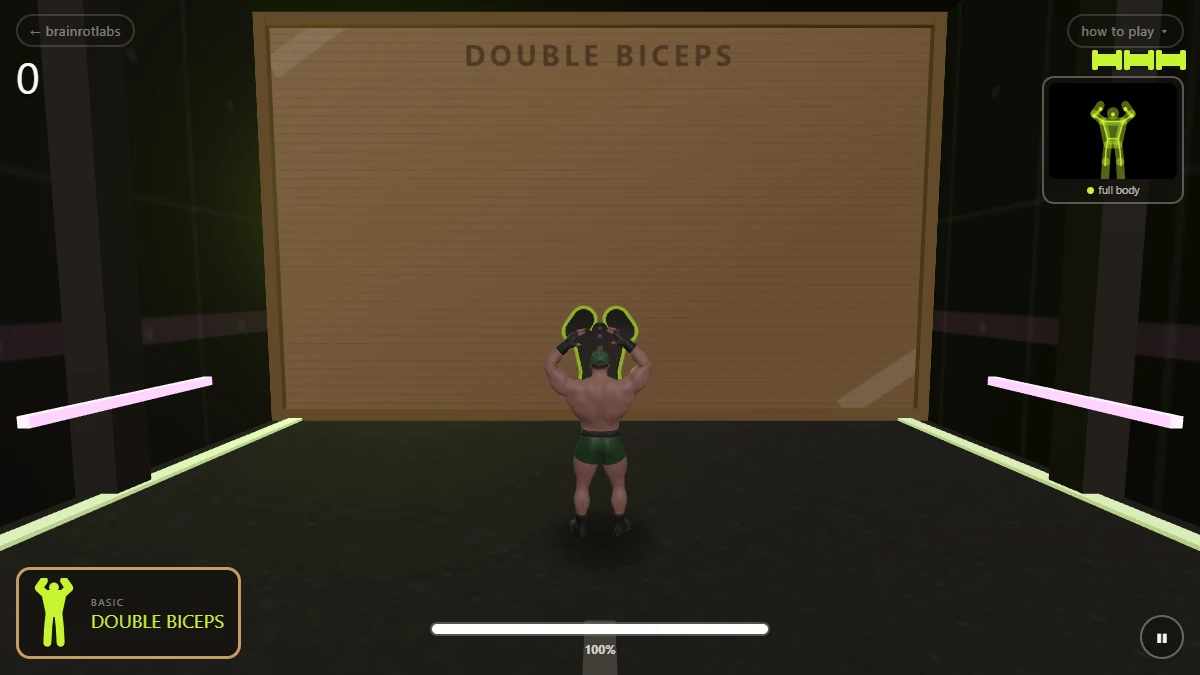
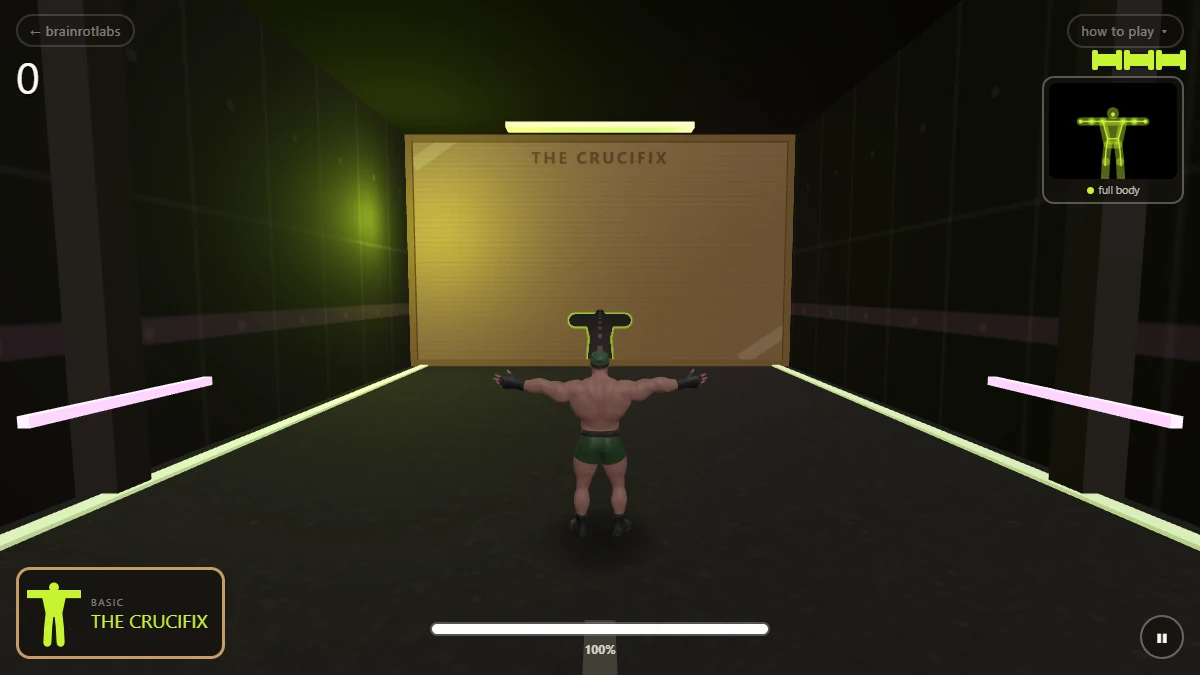
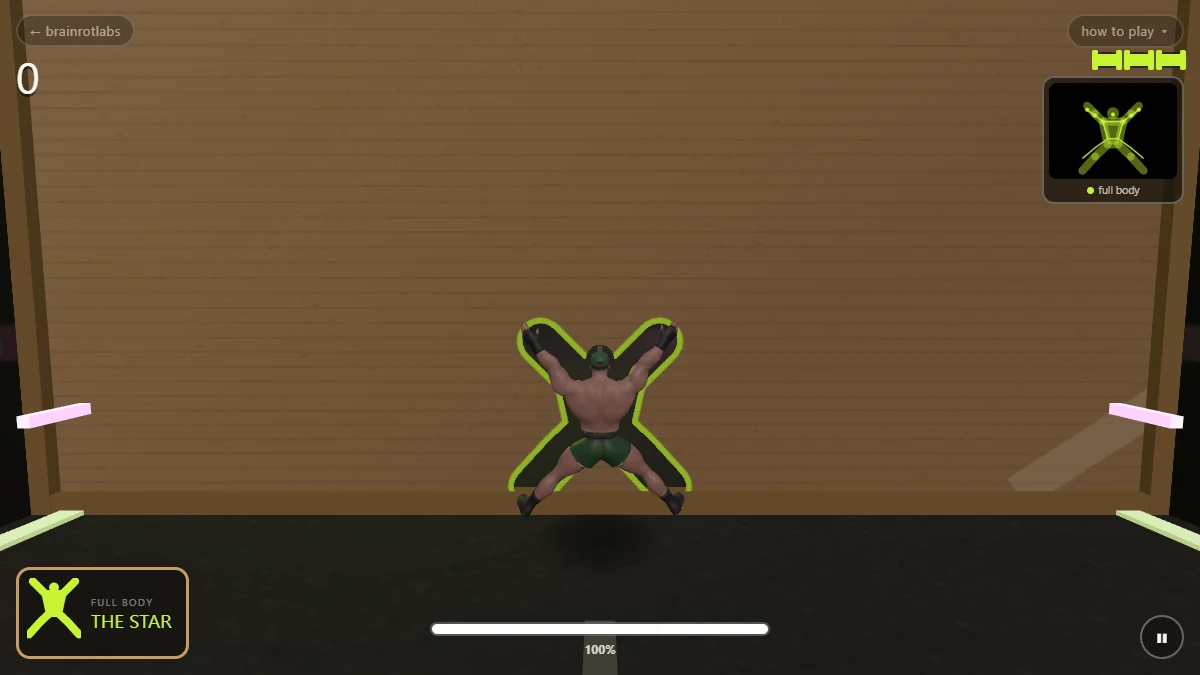
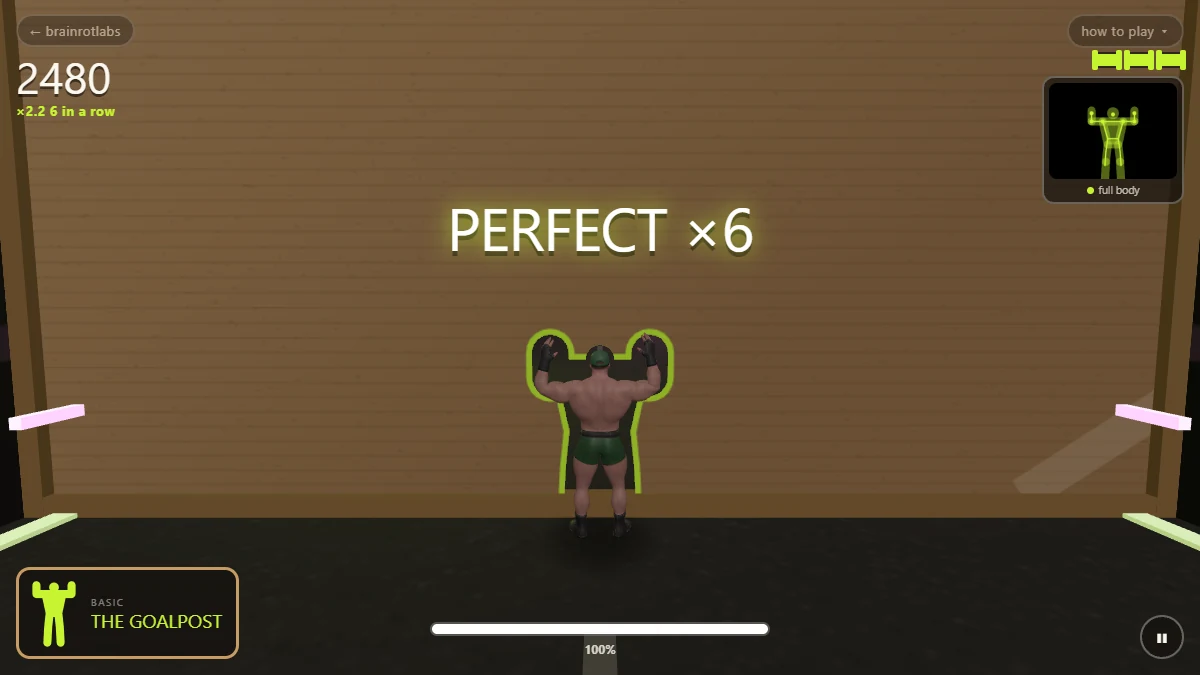
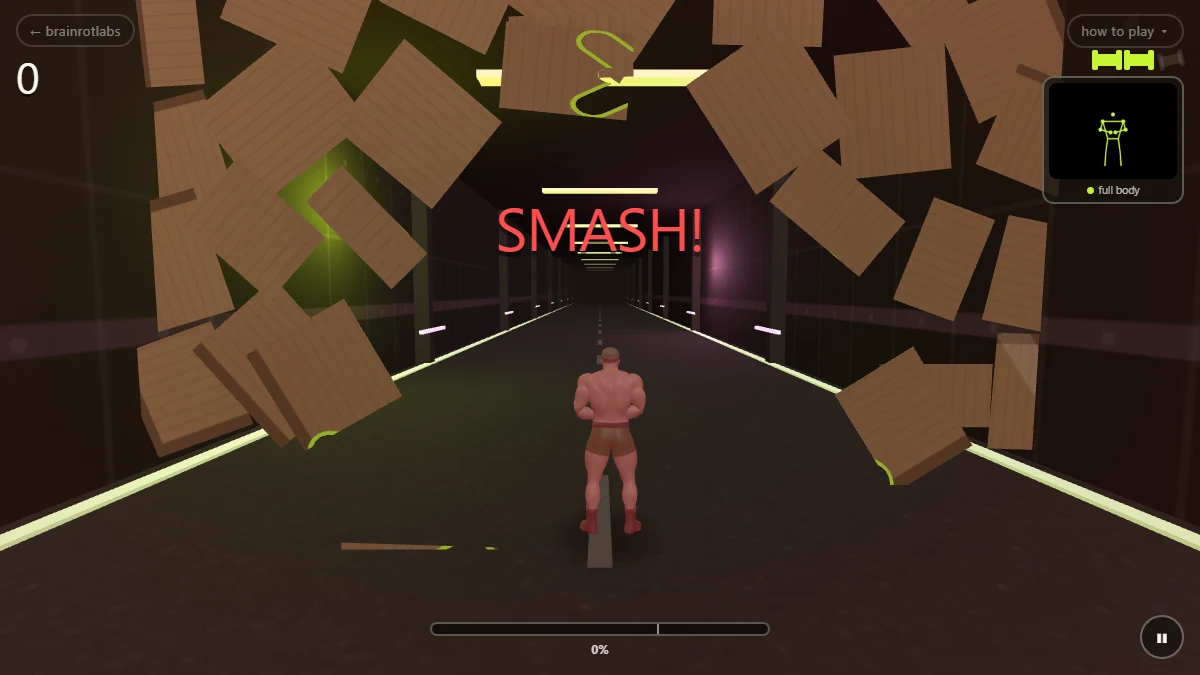
Such a Poser is a free browser game you play with your body. You are a bodybuilder sprinting down a corridor that does not end, and every couple of seconds a sheet of cardboard comes at you with a person-shaped hole cut out of it. Get into that shape before it arrives and you go through the hole. Do not, and you go through the cardboard — and you only have three of those in you.
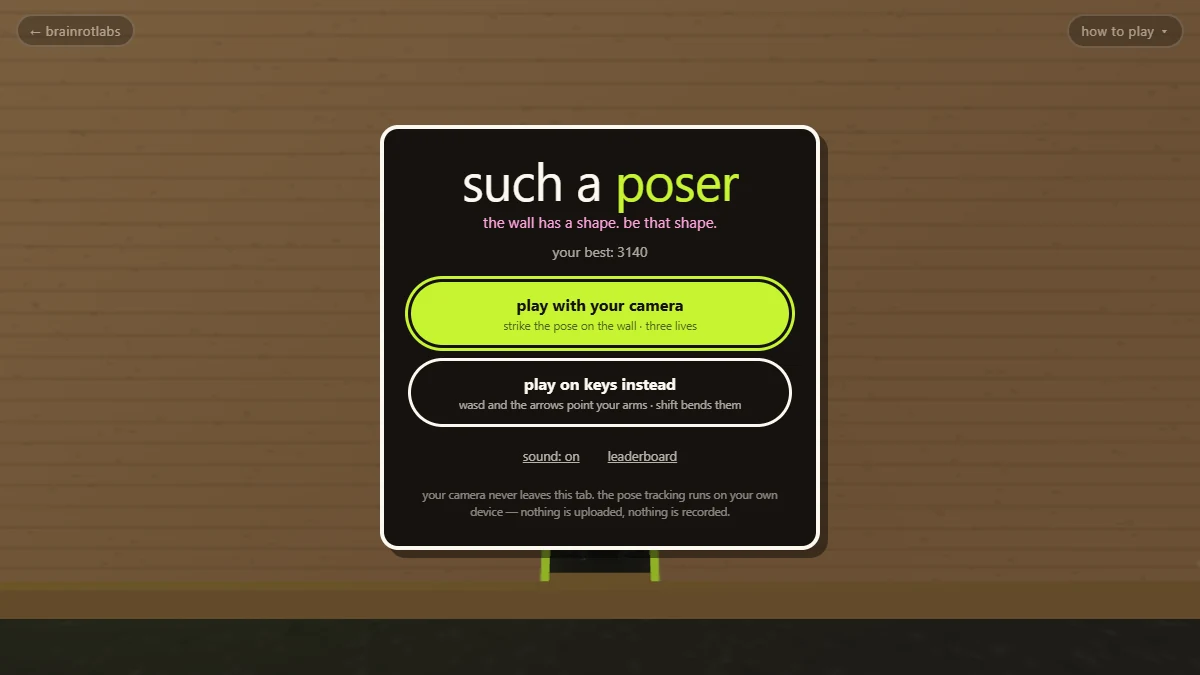
Your webcam is the controller. A pose model runs inside the tab, measures which way each of your limbs is pointing, and compares it to the cut-out. Nothing is uploaded and nothing is recorded — and if you would rather not turn a camera on at all, the keyboard plays the whole game under exactly the same rules.
how to play
With the camera, there is nothing to learn: you point your arms where the hole points its arms. Everything is mirrored, like a mirror — the arm on the left of your screen is your own left arm, the hole on the left of the wall is for it, and the bodybuilder (who is copying you, not the wall) raises the same one. There is no mental flip anywhere in the game.
On keys, each key points one limb somewhere and the same matcher judges the result:
- your left arm — W up, A out, S down, D across your chest. Two together give you the diagonals: W+A is up-and-out, A+S is down-and-out.
- your right arm — the arrow keys, same idea: ↑ up, → out, ↓ down, ← across.
- bend an elbow — the shift on that side of the keyboard. Q and / do the same job for hands that would rather not go looking.
- your legs — space for legs apart, Z to put your left leg out, C for your right.
- pause, mute, restart — P, M, R.
On a phone or tablet, drag on your half of the screen to point that arm and put a second finger down on the same side to bend the elbow. Three buttons along the bottom handle the legs.
the rules
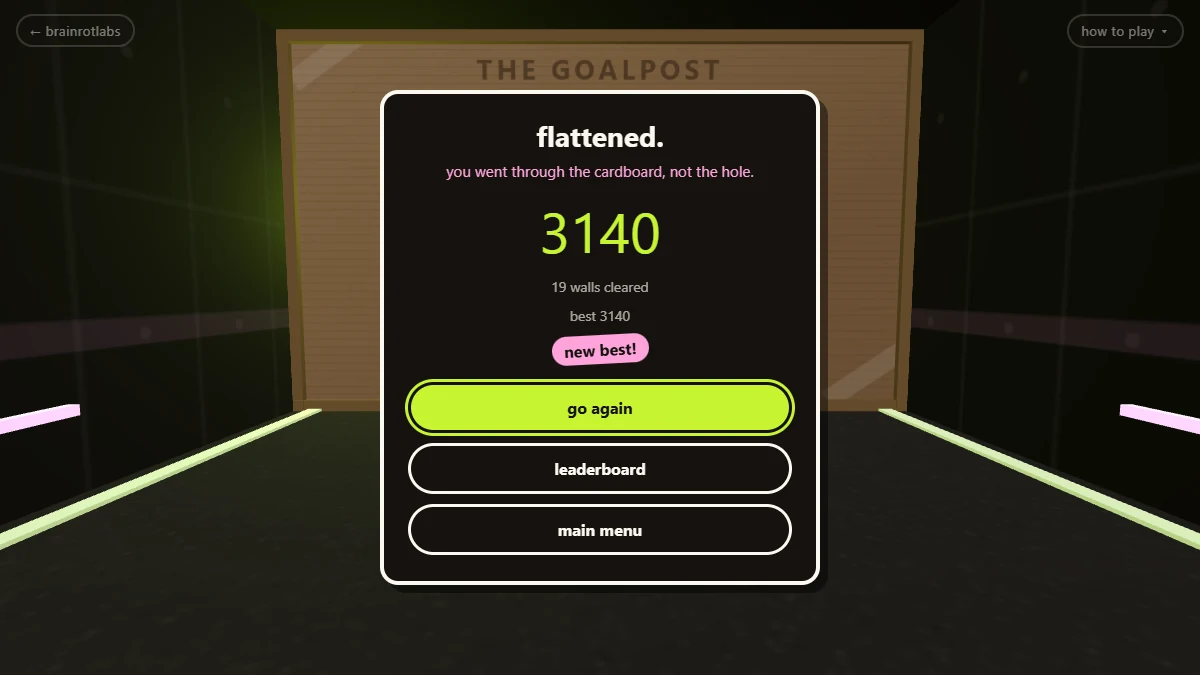
- Three lives. Every wall you fail to match takes one, and there is no way to earn them back.
- You are judged on angles, not on where you stand. The game measures the direction each limb points relative to your own shoulders, so it does not matter how tall you are, how far from the lens you sit, or where in the frame you stand. There is nothing to calibrate.
- Every limb the pose asks for counts. Getting seven eighths of a pose and leaving one arm hanging is not a pass — that arm is the one going through the cardboard.
- The best moment counts, not the last one. Your score for a wall is the best match you held while it was on top of you, so snapping into a pose and wobbling out of it still gets you through.
- Sitting down is allowed. If the camera cannot see your legs you are only ever dealt poses that are about arms.
- It speeds up. Every wall you clear makes the corridor faster and the judging a little stricter. What gets hard is not the pose — it is having time to get into it.
- One last chance per wall. If you are nearly in the pose when a wall is about to hit, the world slows down for a moment. It will not save a pose you never attempted.
scoring
A clean wall is 100 points, a PERFECT is 160, and every wall in a row multiplies the lot — up to four times. A smash costs a life and resets the multiplier, which is why the three walls after a mistake are the expensive ones. Your best is kept on your own device, and a run good enough for the top 100 can be posted to the world board under a name you choose once.
tips
- Learn the seven basics. THE CRUCIFIX, HANDS UP, THE BIG Y, DOUBLE BICEPS, THE GOALPOST, HANDS ON HIPS and MOST MUSCULAR make up most of the early walls and never stop turning up. Poses you can strike without thinking are what carry you once the corridor is quick.
- Watch the meter, not the wall. The bar along the bottom is the live match, with the pass mark drawn on it. If it is stuck at eighty, one limb is wrong and the meter will name it.
- Elbows are the usual mistake. A straight arm and a bent arm pointing the same way are two different poses, and the cut-out says which one it wants.
- Get big. Half-hearted poses land halfway between two library entries and score as neither. Throw the limb all the way to where it is going.
- Stand back. More of you in frame means steadier tracking, and it is the only way to unlock the full-body walls, which are worth the same as any other — but come with the fastest part of the run.
- Protect the multiplier. At a streak of fifteen every wall is worth four times what the first one was, so a wall you are not going to make is still worth throwing the nearest pose at.
screenshots
your camera and your privacy
The camera is opt-in: the game never asks for it until you press play with your camera, and the rest of the site cannot ask for it at all. When you do, the pose model is downloaded once and runs inside your browser tab. Frames go from your camera into that model and nowhere else — they are not uploaded, not recorded, and not sent to us or to anyone. Close the tab and there is nothing left. The details are in our privacy policy.
features
- your own body as the controller, with on-device pose tracking and nothing uploaded
- a library of thirty poses, from a plain T to one-legged flamingos
- a live match meter that tells you which limb is wrong before the wall arrives
- a ghost of the pose drawn over your camera preview, so you can see the gap
- a bodybuilder who copies you rather than the wall — the fastest feedback in the game
- three lives, a combo multiplier, and a corridor that keeps getting faster
- a world top-100 board, and a best score kept on your device
- keyboard and touch controls that play the whole game and are scored identically
frequently asked questions
Is it free?
Yes. It runs in your browser with no download, no install and no account, on desktop and on mobile.
Does my camera video go anywhere?
No. The pose-detection model runs inside your own browser, so camera frames are analysed on your device and discarded immediately. No video, images or body-position data are uploaded, recorded or stored, and none of it reaches us or anyone else. See our privacy policy.
Can I play without a webcam?
Yes, and it is the same game. The keys point your limbs and the same matcher judges the result, so a keyboard run can score PERFECT for the same reason a camera run can — because you got into the pose. W, A, S and D point your left arm, the arrows point your right, the shift on each side bends that elbow, and space, Z and C move the legs.
Do I need to stand up?
No. If the camera cannot see your legs the game only deals you poses that are about arms, so it plays perfectly well sat at a desk. Stand back far enough for your knees to be in shot and the full-body poses start turning up — the check before each run tells you which mode you are in.
Why did that not count? I was in the pose.
Watch the meter while you hold it. The score blends the average of your limbs with the single worst one, so a pose with one arm left hanging fails even though the rest of you was right — and the commonest culprit of all is a straight elbow where the wall wanted a bent one. Once you are close, the meter names the limb costing you the most.
The wall says LEFT GUN — whose left?
Yours. The preview is mirrored like a mirror, so the arm on the left of your screen is your own left arm and the hole on the left of the wall is the one it goes through.
How many lives do you get?
Three, and you cannot earn them back. A smash also resets your combo multiplier, which over a long run costs more than the life did.
It is too fast.
It is meant to get there — the corridor speeds up with every wall you clear and the judging tightens as it goes. The answer is not to react faster but to know the poses well enough that reading the wall and striking it are the same motion.
What do I need to run it?
Any modern browser with WebGL. For the camera you also need to allow camera access when the game asks — which it only does after you press the camera button. It works on phones, though standing where the front camera can see your arms is the trick.
Who made it?
It's made by brainrotlabs, a tiny independent studio that builds its web games entirely in code. Read more about the studio.